















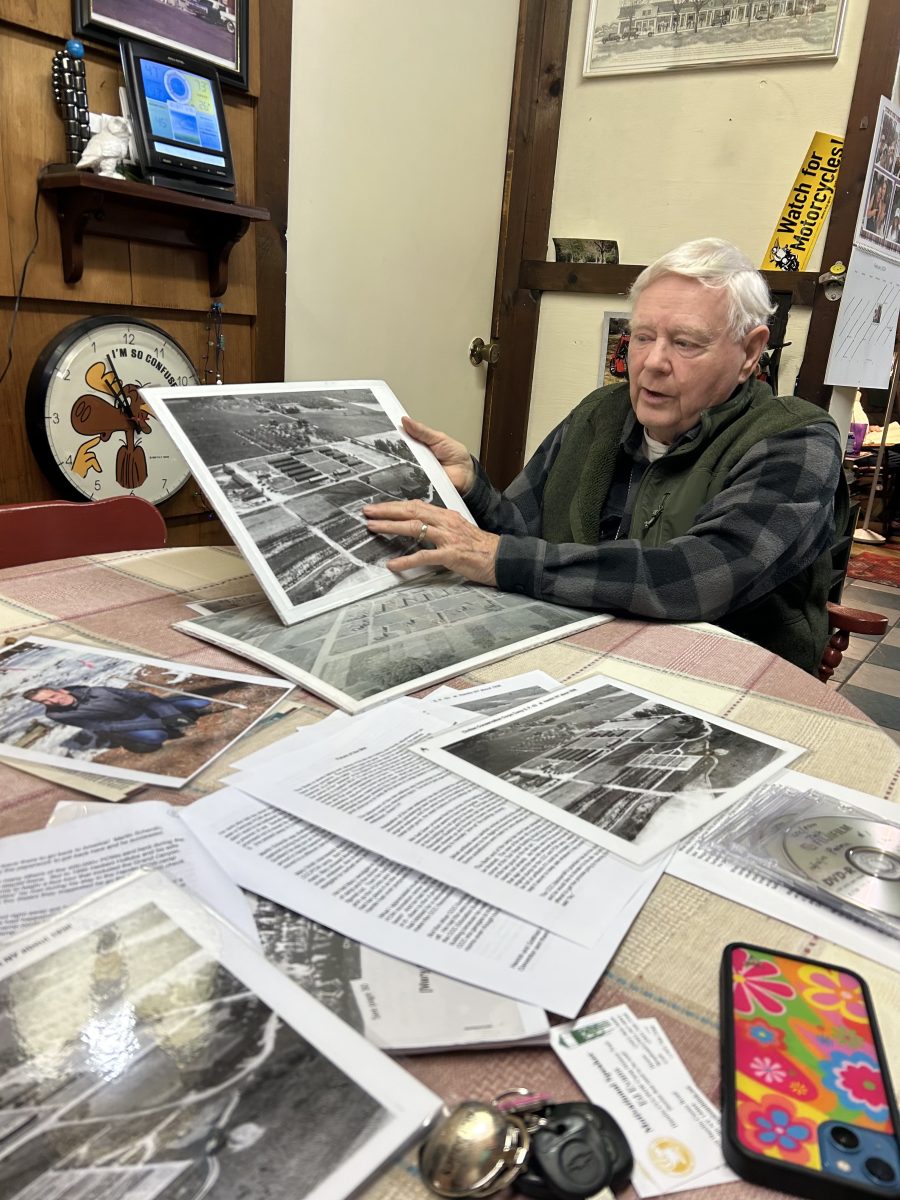
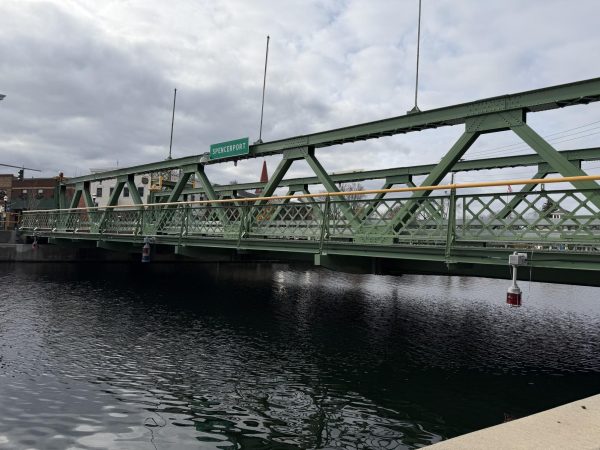
The scene is familiar to almost anyone who grew up in a New York classroom: a roomful of fourth graders belting out “Low bridge, everybody down!” while textbook illustrations of the Erie Canal glow on the overhead projector. But beyond those childhood sing-alongs runs a modern canal lined with lift bridges—distinctive vertical spans that continue to open for boat traffic, interrupt Main Streets and morning commutes in a way unique to upstate New York.
Construction began in 1817 to solve a simple problem: moving goods from the western frontier to the Atlantic was slow and expensive. Roads were rough, rivers unreliable, and overland transport could take months. The solution was ambitious: a 363-mile canal linking the Hudson River to Lake Erie, creating the first continuous inland route between the Great Lakes and the Atlantic.
When it opened in 1825, freight that once took months overland could move by water in nearly half the time, at a fraction of the cost. New York City became the nation’s busiest port, and towns along the canal, from Buffalo to the Mohawk Valley, grew quickly. The canal didn’t just move goods—it connected regions, encouraged migration, and fueled New York’s rise as an economic powerhouse.
Brad Utter, senior historian and curator at the New York State Museum and author of Enterprising Waters: New York’s Erie Canal, told BBC Travel, “If [it was] not the most important manmade development of the 19th Century, this one set the stage.” He compared the canal to the internet: “Once it opened, you could get goods from Rochester to New York City in a week or two, instead of a month or more. It was, and still is, all about getting things faster, shrinking time and space.”
LIFT BRIDGES: INNOVATION ALONG THE CANAL
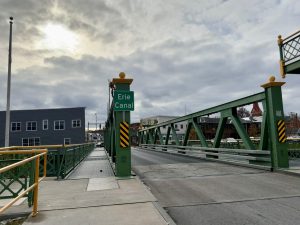
As traffic grew, the canal was upgraded in the 1918 New York State Barge Canal project. Sections were widened, some routes rerouted, and bridges were added to carry roads and railways over the water. Early bridges were fixed structures, but as boats grew larger, engineers needed a solution that allowed taller vessels to pass without disrupting land traffic. This led to the invention of vertical-lift bridges—movable spans that can be raised using counterweights and pulleys.
Many of these lift bridges, including Brockport’s, still rise today. They are living links between the canal’s 19th-century beginnings and its 20th-century modernization, reflecting both the ingenuity of engineers and the ongoing importance of the Erie Canal to communities along its route.
HOW LIFT BRIDGES WORK:
Vertical-lift bridges are designed to let boats pass underneath without stopping road traffic. Unlike fixed bridges, the central span can be raised straight up, guided by towers on either end. Counterweights and pulleys balance the weight of the span, allowing it to lift smoothly with minimal energy.
This design was critical for the Erie Canal. As boats grew larger and commercial traffic increased, fixed bridges became bottlenecks. The lift bridge allowed the canal to handle bigger vessels while still carrying roads or railways above. Brockport’s Main Street lift bridge uses this system: when lowered, it carries cars and pedestrians over the water; when raised, boats can pass freely beneath.
For communities like Brockport, these lift bridges aren’t just engineering feats—they are vital parts of daily life, a fact that became clear during a recent long-term closure of the Main Street bridge.
BROCKPORTS LIFT BRIDGE: RECENT CHALLENGES & REVIVAL
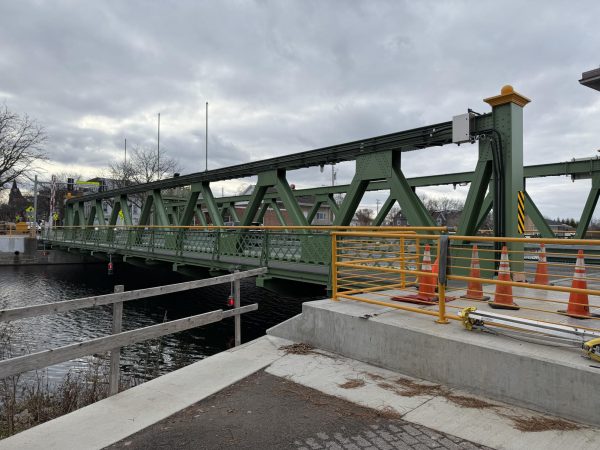
When the bridge closed in May 2023 for major rehabilitation, delays left local businesses struggling.
Co-owner of Lift Bridge Book Shop Sarah Bonczyk told Spectrum News, “We saw our regular business drop by roughly half — it was a real challenge for everyone on Main Street.”
Monroe-County Legislator Jackie Smith told Spectrum News the repeated delays “upended the lives of everyone in our village, from families and workers to the small businesses that are the heart of our community.”
The bridge finally reopened on November 10, after upgrades to the deck, trusses, and lift system. Bonczyk reflected on the reopening:
“There’s a lot of hope. To get this back to the main street, it would be blossoming. So, there’s hope. There’s more hope, for sure, than anything.”
The reopening restored the bridge’s function, brought traffic and commerce back to downtown, and preserved a historic part of Brockport’s identity.
A CLOSER LOOK: FAIRPORT’S UNIQUE LIFT BRIDGE
The Fairport Lift Bridge, built between 1913–1914 as part of the Barge Canal expansion, replaced an earlier fixed bridge that could no longer span the widened canal.
What makes this bridge unique is its geometry. It crosses the canal at a 32‑degree angle, slopes southwest to northeast, and is constructed as an irregular decagon — no two angles are the same, and the deck has no square corners. Originally built with a wooden deck, it has since been updated with steel grating, while preserving the distinctive bow‑string truss design and skewed shape.
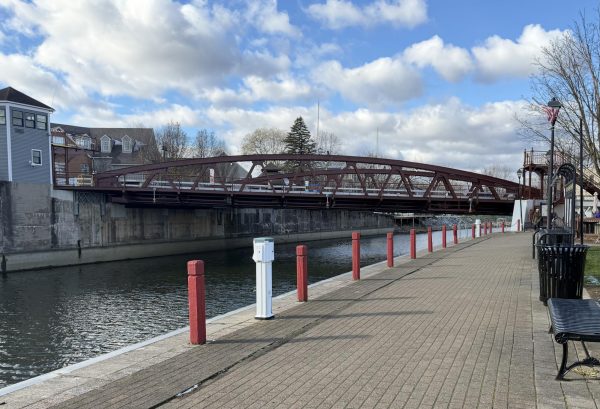
Recognized as a village landmark in 2009 and later listed on the National Register of Historic Places as part of the Barge Canal system, the Fairport Lift Bridge demonstrates how lift‑bridge design could adapt to challenging terrain and pre-existing street layouts. It balances functional necessity with architectural creativity, showing that Erie Canal lift bridges are not just infrastructure—they are historic landmarks with character and heritage.
PRESERVATION. AND MODERN CHA.LLANGES:
Keeping the Erie Canal’s lift bridges working is no small task. Most are more than a century old, built with early mechanical systems that rely on gears, counterweights, and parts that often have to be custom-made. Maintaining them means preserving their historic character while making sure they can still handle daily traffic and occasional canal navigation.
Upgrades are necessary, but they can be disruptive. Rehabilitation projects—like the recent work in Brockport—often require long closures that affect commuters and put pressure on nearby businesses. Still, without these investments, the bridges wouldn’t be able to meet safety standards or keep operating as intended.
Across the canal corridor, communities and engineers face the same challenge: honoring the bridges’ heritage while ensuring they remain reliable, working pieces of the landscape rather than relics.
WHY LIFT BRIDGES STILL MATTER:
In towns along the Erie Canal, lift bridges do more than move traffic or clear a path for passing boats—they hold together the story of how these communities came to be. Each time a bridge rises, it reconnects the present to a long chain of innovation, expansion, and local life that began more than two centuries ago.
They matter because they still serve the purpose they were built for, and because their presence shapes the daily rhythms of the villages they stand in. In places like Brockport and Fairport, the bridges aren’t just infrastructure; they’re landmarks people orient themselves around, symbols of continuity in towns that have grown and changed around them.
As the canal evolves and new challenges emerge, these bridges remain a reminder of how engineering, commerce, and community have always intersected here. Preserving them means preserving the character of the canal corridor itself—and keeping a piece of New York’s history working, visible, and connected to everyday life.